
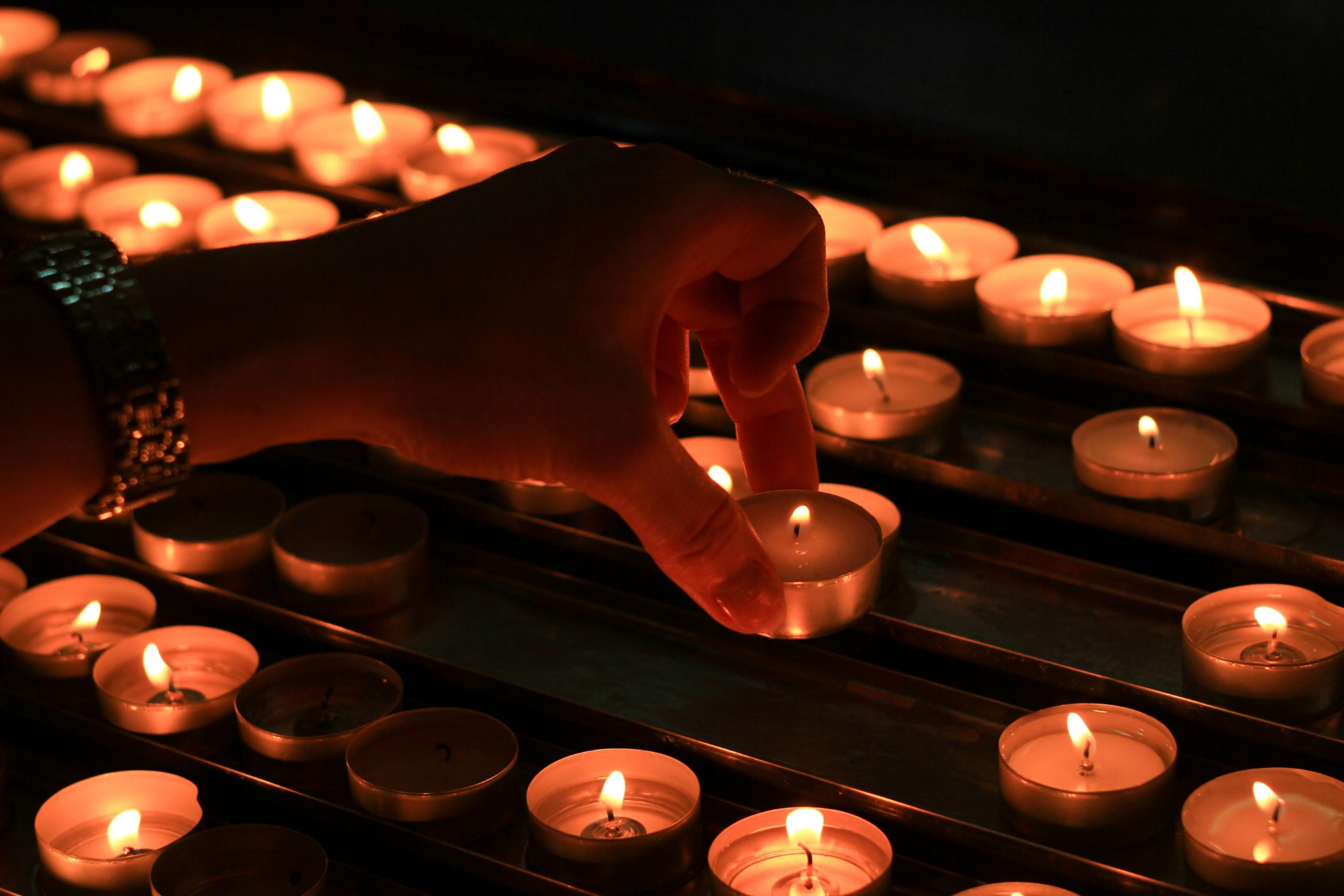
HOW TO PRAY?
Very few people know how to pray—they do not pray; they do business. They would start off by saying, “Oh, Lord, if my son passes his examination, I will donate a hundred dollars to the FISU.”
If my son passes the examination. If. Then, I will donate the hundred dollars to the FISU. That is doing business with God. That is the kind of prayer that is commonly done. Why not give that first? And have the faith that, “Lord, I have done my duty, right, and do whatever You think is right if my son deserves to pass or not.”
We are forever requesting, not only requesting but demanding. There is nothing wrong with that: request and demand. However, one factor must always be considered: Do I deserve what I require? It is excellent to demand the moon, but do I deserve that?
If a person goes through self-analysis, which is a perfect thing, evaluating where one stands is an excellent thing. Suppose the demand is based upon a real need, which circumstances have brought about, and we know that our actions and thoughts in life have been such that that need must be fulfilled. It will be fulfilled in that case because we have created conditions that will automatically fulfil the need. In prayer, we do not make demands. We do not do business.
The best way to pray is by a certain kind of affirmation. These affirmations are not necessarily repetitions of specific formulas. When you sit down in your meditation, and just as your meditation is about to end, you picture the position you want to be in your mind’s eye. If you want a new motor car, then when the mind is quiet after meditation, picture yourself driving that new motor car. Picture yourself possessing that motor car. That does not mean that the Buick will stand outside as soon as you come out of that meditation.
MAN IS THE MASTER OF HIS DESTINY
We have said before that man is the master of his destiny by repeatedly putting yourself in that position of seeing yourself possessing that motor car, driving it, going on the seventeen-mile drive. Having this repeated affirmation, you imprint your desire very strongly in your mind by repeating the picture you create. Because the mind is mighty, your mind is so attuned to what you want that the force of your mind will attract certain circumstances to you and around you. We do not believe in lotteries. It will attract you to certain kinds of work and specific circumstances where you will be the proud possessor of that Buick. That is prayer.
So, who answers your prayer? You answer the prayer by conditioning your mind to a particular set of circumstances.
Divinity is a neutral energy. When we say, “God gives,” theologically, there is some truth in it. But because Divinity is a neutral energy, it depends upon you how to use it, and this neutral energy has to be filtered through your mind.
Orientate yourself to the thoughts of poverty, poverty, poverty all the time, and you will become poor. Orientate your thoughts to riches all the time, and you can become rich materially or spiritually; that is your choice.
We have seen the pitfalls of putting too great an emphasis on materiality and the advantages of putting a greater emphasis on spirituality. One could be very temporary happiness. I still have to meet a rich man who is happy. But I can show you spiritual men who are totally happy even though they do not possess more than two shirts—while one is being washed, he wears the other one.
THE HAPPIEST MAN ON EARTH
There is a lovely story about Emperor Akbar, who lived in India about four hundred years ago. He wanted to find the happiest man on Earth, so he sent out all his generals and advisors, and everyone went everywhere with a questionnaire. They went to rich people and asked the question, “Are you happy, are you really happy?” and everyone had some problem. Finally, all these soldiers and market researchers, who would call them today, went out questioning people, and they could not find anyone happy. Then his prime minister thought, “Look, they have all tried. Let me go out now and see what I can find.”
He went out, travelled, travelled, questioned, and questioned, and found no one happy. Then, as he was coming backcrossing the river, he saw a man sitting on a little boulder in the middle of the river, just being in joy and singing away and splashing the water. He went up to him and said, “Are you happy?” This man said, “Yes, I am happy.” Of course, the Prime Minister was no fool, so he questioned the man from various angles, and he discovered that this man was happy. Yet this man who was so happy did not have a shirt on his back.
WE ANSWER OUR PRAYERS OURSELVES
When it comes to prayers, no one answers our prayers but ourselves. When we try to condition our minds to specific circumstances or material possessions, let us also be sure that within the material acquisition, there is a spiritual element.
As we described, what we are doing in prayer is using this divine energy, which we filter through our minds and use to make the maximum use of this energy in whichever way we want. The choice is ours. That is why man has been given free will.
We are praying to the Divine in us. In other words, we are using the Divine as a focal point of our attention, and the purpose of using a focal point of our attention is so that all the scattered energies of the mind can be brought to one-pointedness. That is what Tratak’s practice does for us. It teaches us how to take scattered energies and bring them to one focal point. When we have achieved a certain measure of how to get the scattered energies together to a focal point, we can use it in whichever way we want. Then, our thoughts become more powerful, our prayers become more powerful, and everything we do becomes more powerful.
It is my personal experience that I need to think of something, and it happens. This is personal proof of the teachings I teach. I never teach anything without having experienced it first. You will find that whatever I say, I have practised first. All my teachings come from deep experience, which I have experienced and lived.
… Gururaj Ananda Yogi: Satsang US 1977 – 10