
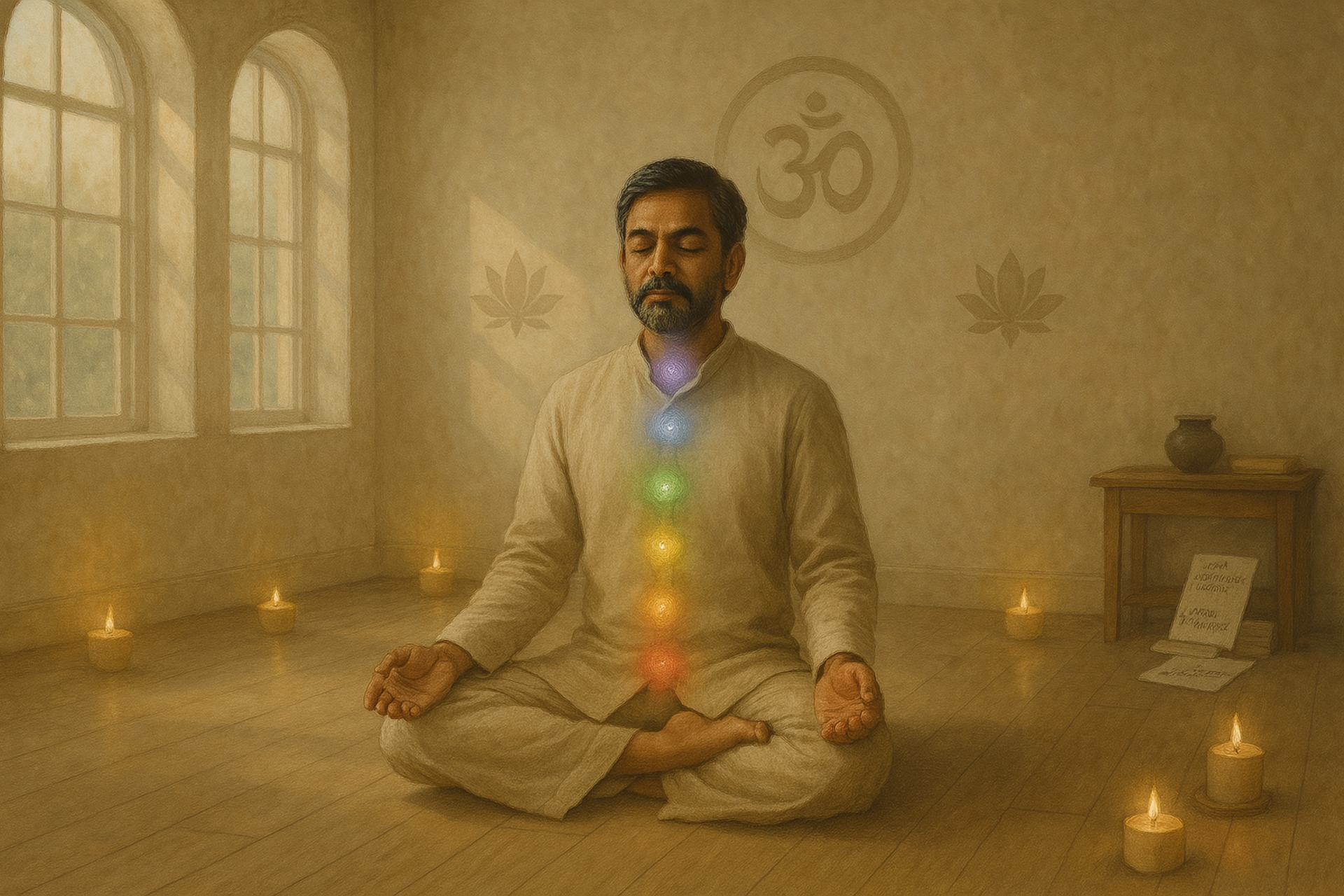
RAJA YOGA PART 1
RAJA YOGA: THE ROYAL PATH TO DIVINE UNION
We are all mechanics. We are the mechanics of our lives. We can tighten screws and loosen them, and of course, the most essential screws to be tightened are somewhere up there. As you would know, Raja means royal, so Raja Yoga is the Royal Yoga, the Royal Path to Divine Union, where the individual self merges with the Universal Self, where man finds union with God. That is Yoga.
In the world today, the word “Yoga” is misunderstood. It has only been understood in the term all those fancy poses, all the Asanas, as they are known. Although Asanas have great value, they do not constitute the entirety of Raja Yoga. It is a part of Raja Yoga, known as Hatha Yoga. Hatha means “To be very adamant on one particular aspect,” that is Hatha. So, that is a section of Raja Yoga. Many teachers teach Raja Yoga, but only a particular aspect they tell you about meditation. Now, there are various forms of meditation.
Some teachers tell you to meditate for so many minutes in the morning and so many in the evening, and Bob’s my uncle. That is not true. If you meditate so many minutes in the morning and so many minutes at night and everything comes right, it is not true. It is a fallacy, a gimmick given to a susceptible, gullible public who wants everything instantly – instant coffee, pudding, and self-realization.
The path of yoga is not as simple as it seems. As Vivekananda has said, yoga is the path of the heroes and warriors. There has to be determination. Krishna has said, “There are few types of people that want to reach me: the one that is in distress, the one that wants worldly gain, the one that is a seeker and, last but not least, the one that has real spiritual knowledge and wants to remain forever in touch with his Maker. He wants to be at home always and not stray away.”
Raja Yoga, as we said, is the Royal Path to that union. Why is it called the Royal Path? Raja Yoga combines all the other yogas: Karma Yoga, which is about right action and correct thinking, and Jnana Yoga, which is about intellectual analysis and seeking answers. It combines Bhakti Yoga, devotion, surrender, and love yoga. Wherever one starts from, according to one’s temperament, they all finally merge into one, the royal or the Raja yoga.
Some people say that there are eight steps in Raja Yoga. They are not to be regarded as steps, but they are limbs. Raja Yoga by Patanjali was called Astanga Yoga. Asta means eight; anga means limbs – the eight limbs of yoga. Let us examine the eight limbs of yoga as far as we can, as time allows. Meditation is fine, but if meditation is not backed up with the first two limbs, Yama and Niyama, then meditation can be of some value; it can give you some form of relaxation of mind and body, but it is not enough to lead you to enlightenment, or to the oneness that we all seek.
YAMAS HAS FIVE ASPECTS TO IT – AHIMSA, SATYA, ASTAYA, BRAHMACHARYA & APARIGRAHA
AHIMSA: NON-VIOLENCE
Yama has five aspects; the first is Ahimsa, which means non-violence. How shall we define non-violence? We have spoken about non-killing, and we covered a bit of ground there. To be non-violent does not only mean avoiding the killing of living beings or animate things, but non-violence also means a non-aggression upon ourselves and those around us. Having an animal nature, we become aggressive, perhaps not in acts but in words and thoughts. So here, one has to make a very conscious effort to curb one’s aggressive thoughts and one’s aggressive words. A lovely Chinese proverb says that when you become angry and want to say some angry words, turn your tongue around in your mouth nine times. Beautiful psychology because by the time you have turned and twisted your tongue in your mouth nine times, your anger will have disappeared, and you will not utter those words. You will not be aggressive because you can kill with words, and we know how vitriolic some people can become by uttering words of an aggressive nature. We can do so much harm to a person’s entire life. If we are aggressive with a stick, that wound will heal in a few weeks or a month or two, but if we leave a scar on a person’s mind, that scar can remain for a lifetime. We find parents, for example, in the ill-treatment or not proper treatment, or not proper upbringing of the children, leave an indelible scar for which the child, when grown-up, suffers and suffers, and suffers. That is one of those in distress that wants to find a union.
SATYA: TRUTHFULNESS
After Ahimsa, that has to be practiced consciously, we have Satya. Satya means truthfulness. Truthfulness does not only imply uttering words of truth but acting truthfully. We know how fragmented the human being is. His mind will think of one thing, his mouth will say another, and he will do a third thing. That is being untruthful to oneself. To be untruthful to oneself means you say one thing, think another, and do yet another thing. So, you are pulled to pieces by yourself. If we can consciously combine words, thoughts, and deeds, then we are being truthful to ourselves, and when we are truthful to ourselves, we can be honest with others. One of the qualities of truthfulness is sincerity because a sincere person can never be untruthful. Because of that sincerity within him, every act of his, every word of his, every thought of his will always act with the flow of nature and never against nature. We become truthful and sincere when we act with nature’s flow, which we must consciously do. That is the second part of what we have termed Yama.
ASTAYA: NON-STEALING
Then we have number three, which in Sanskrit is called Astaya, which means non-stealing. Non-stealing does not mean robbing the bank only or pickpocketing someone. Non-stealing also carries truthfulness and non-violence within itself. When we are unjust to another, we are being violent to that person, and being violent to the person, we are stealing the peace of that person. What more significant theft can there be than stealing someone’s peace? Stealing implies cheating, unfaithfulness, infidelity, and promiscuity. All these things comprise what we call Astaya, non-stealing. So, it is not necessary that stealing only means money; stealing also has to do with one’s lifestyle, emotions, and how we harm or hurt other people’s feelings. That is Astaya.
BRAHMACHARYA: WALK IN THE PATH OF DIVINITY
Then, in Yama, we have Brahmacharya, the most misinterpreted word ever given out into this world. Many people feel that Brahmacharya means celibacy, complete continence, and non-indulgence in sex. Brahmacharya does not mean this. Brahma means Divinity, and achar means the way or the path. So, to be a Brahmachari, practicing Brahmacharya means to walk in the path of Divinity. That is the true meaning of Brahmacharya. To practice Brahmacharya, one necessarily must exercise some form of control. That control can be about eating, can be about sleeping, can be about drinking, or the sexual act. I have told a story once where a couple came to see me. They were so, so emotionally disturbed. They had met some Swami who said, “To reach God, you must practice celibacy. No sex.” They took Swami’s word; I think he was an intelligent man, and so that is what they did: they practiced celibacy—not being ready for celibacy and not having the ability to sublimate those energies. Remember, celibacy is not for householders; it is not for married people. It is for ascetics where they go through severe asceticism, severe austerities, whereby they can sublimate the sex energy, one of the strongest urges in a human being, whereby they could sublimate that energy into what is called Ojas, light. That is for ascetics, not for the householder. To get back to our story – this couple practiced celibacy. Without being able to sublimate their sexual urges and energies, they started having problems, emotional problems.
The husband and wife were forever irritable with each other. They were creating unnecessary inhibitions within themselves, unnecessary repressions. And the result was that they started becoming unhappier and unhappier. Where there was such compatibility, they started becoming incompatible. And, of course, the psychiatrists made a lot of money from it. So, they heard about me, and they came to our center in South Africa, and I spoke to them and asked them what the problem was. So, I said, “You go to bed tonight in a double bed.” After a while, they came to see me again, and they were their old, same old selves again, so happy.
So, Brahmacharya must not be interpreted only in terms of complete abstinence. Still, it must be interpreted in terms of walking along the path of Brahma and the path of Divinity. And when anyone walks along on the path of Divinity, he has to exercise all forms of control within himself. So, you see how non-violence, non-stealing, and truthfulness merge into that. Yama is one principle with these various aspects, which all merge into that oneness again.
APARIGRAHA: REJECTION OF ALL TIES
From Brahmacharya we reach Aparigraha. We have Aparigraha, which means rejection of all ties. As householders, we cannot reject all relationships. The ties that are to be rejected are the unbalanced attachments. In the world, we find that some people are unnecessarily attached to things that mean absolutely nothing. I have seen a lady in whose home the maid very inadvertently broke the vase, and she nearly had a nervous breakdown. I do not know if she thought she was going to take that vase with her, but her attachment to it was so much, and the attachment not only to the vase but also to the attachment of those that had passed on before her, her mother, her grandmother, her grandmother’s grandmother. They are gone; they have reached another sphere. But because of that emotional attachment, all those things that passed away out of her life and that could be of no consequence in her present life were all centered in this vase. That is the wrong attachment.
One should not have detachment, but one should have non-attachment. There is an excellent difference between detachment and non-attachment. Detachment means that you become indifferent to the world. You seclude yourself from the world. You withdraw yourself from the world in detachment; in most cases, that is a form of escapism.
I have seen detached people through my travels in the Himalayas, the various Ashrams, and worldwide. All those Yogis Saddhus and Ascetics were nothing but escapists. They could not face life; they could not face the world. They could not handle their problems and troubles, so this was the easy way out. There was a time in India when there were six million Saddhus. They call them Saddhus, and I call them parasites. They live on the fat of the land, do not want to work, and go around begging for their food. Of the six million, there might have been six who were sincere. There might have been six; the others were sick. Escapism is when people cannot handle themselves and become detached from the world. That is detachment.
What we want is non-attachment, where you are functioning in the world. You have three square meals daily; you love your wife and children and are close to them. You have all the ties – a wardrobe full! Yet you are not emotionally attached. That is what the Bible means when it says, “To be in the world, but not of the world.” That is what is intended. It does not mean running away. It means come, be in the world. And if everyone starts running away from this world, I tell you what will happen: the cities will be emptied, and new cities will be built in the jungles. So, you still live where you are.
Man can never run away from himself. A geographical change does not help. So, in non-attachment, we face our problems. We face them squarely and try to find solutions, and if we are sincere enough, we find solutions because there is no problem that has not a solution inherent in it. The solution to every problem is in-built, built into the problem.
So, we have talked about Aparigraha, who is non-attached to these ties. It does not mean we do not have relationships, but we view the relationship objectively. View the ties objectively, and when we view these ties objectively, we forget the curse of humanity. And the greatest curse on the head of humanity is “me and mine.” Me and mine. This is mine, this is mine, this is mine when it is ours. We are just on loan here, on holiday. We do not even belong to ourselves; we belong to the Almighty. But as we have spoken about the ego, the ego assumes all supremacy and says I, I, I. That is only an Idea. It is an idea, a function of the mind, created by the mind. This little I, which I call I, I, I, and which causes all this me and mine, is an idea of the mind.
So, when we start recognizing that the whole world does not revolve around me, and funnily enough, that is what people think, all their troubles are because they believe everything revolves around them, everything that happens to them. What me? That is why there is such little love in this world; everything is just me, not you, me. If you write “ME” and have a reflection of it, that I look like WE. And when we start functioning and understanding the meaning of WE, there is no ME. And when there is no me, there is no mine.
All this falls under Aparigraha, the unnecessary attachments we attach so much importance to. That is one of the limbs of Raja Yoga.
NIYAMA TOO HAS FIVE ELEMENTS TO IT – SAUCHA, SANTOSHA, TAPAS, SVADHYAYA & ISHVARA PRANIDHANA
SAUCHA: INNER AND OUTER CLEANLINESS
From Yama, we would proceed to Niyama. Niyama, too, has five aspects. The first aspect of Niyama is Saucha – a Sanskrit word that means “inner and outer cleanliness.” Outer cleanliness does not necessarily refer to the body, although it is part of it, but outer, in this sense, could also mean the environment and how we react to it. Inner cleanliness necessarily involves correct thinking. A person who has wrong thinking can never be clean inside.
I was reading a form this evening, a review report, and this person just wrote two, three, or four words, and they were so beautiful; I was so touched. This person said, “I feel clean inside through my practices.” Beautiful. Tears came out of my eyes. How beautiful it is to feel clean inside. How do we become clean inside? Right action, proper thought, right feeling. All these things we have been talking about can be done consciously. We can curb many of the things that happen in our lives. So, we have inner and outer cleanliness. If we practice Yama correctly, with non-violence, truthfulness, Astaya, Brahmacharya, and Aparigraha, all these things are automatically so interlinked that we feel clean inside and outside.
SANTOSHA: CONTENTMENT
When we feel clean inside and outside, we find it is Santosha. Santosha means contentment. And that is what every person wants? Contentment. To be contented in whatever circumstances we are placed in. If it rains twice, someone will say, “Oh, it is raining.” If it is too hot, “It is too hot!” What a sad state of affairs. Feel contented. Whatever happens to us is our doings. So let me be contented in acceptance, not contented in sitting back and not doing anything about it. Still, I am content to accept that this is my lot, and I take this and do not worry about it or get nervous breakdowns. That is an aspect of contentment.
So, Niyama contains contentment. So, once we practice the first limb, Yama, we reach Niyama. Please remember that these things do not follow step by step. They are all intertwined. They form part and parcel of each other. By developing one virtue within ourselves, we automatically develop other virtues. If a person is kind, then automatically, he becomes sympathetic, and automatically, he becomes compassionate. If he is of kind, automatically, he would have a sense of service, serving his fellow men. So, all these things are interconnected, all aspects of the one thing.
Santosha also means keeping an equanimity in all that happens around us, pleasure and pain. If we have developed the sense of non-attachment in Yama, we can find contentment, for then pleasure and pain will be viewed objectively and will not have a binding karmic effect upon us. Our problem is that we heap karma upon karma – bad or good, both are binding. But if it can be viewed objectively, then it becomes non-binding, and anything non-binding can never add to karma, and all karma one has to pay for. Whatever you sow, you must reap. You know that.
TAPAS: AUSTERITY
From there, it becomes a little more difficult. We have Tapas, which means austerity. Like Brahmacharya, austerity is also a word that is misinterpreted. Austerity does not mean you deprive yourself; if you have a comfortable bed at home, you will sleep on the ground. It is not necessary. Enjoy life, enjoy – it is shorter than you think. But enjoy it in the right way, and enjoying life in the right way is austerity. That is austerity, enjoying life in the right way.
When a person has the required austerity, he becomes indifferent to extremes because after practicing the aspects of Yama and Niyama, nothing can affect you. Hail, wind, or storm does not affect you because strength is built up in you.
I want to repeat repeatedly that all these things come about by conscious effort and not closing your eyes for twenty minutes in the morning and evening. That is a help. That gives you the strength to put life into practice, and by putting life into practice, we live a practical life. That is what we want, not a sleeping life and most people go to sleep in meditation in any case.
SVADHYAYA: SELF-STUDY
The following principle of Niyama is Svadhyaya – a Sanskrit word that means self-study. Self-study and also study of Scriptures.
Self-study can be interpreted as self-analysis, and it can also be construed as self-evaluation. I have a habit: every evening, while lying in bed, I review for the whole day. What have I done during this day? Has this day been lived well or not? In my case, the answer might be yes, all the time, but nevertheless. I am very fun-loving because life is joy, so be joyful. For example, you know one thing that hurts me very much is that our beloved Jesus is always portrayed with tears running down his eyes. He might have had eye problems like me. But I tell you that he was one of the most cheerful men on earth because he said, “Be of good cheer,” and Jesus would not preach anything he did not practice. Remember that. So be of good cheer – let us laugh.
So, self-study means self-analysis, and it also implies self-evaluation. When I go to bed at night, I evaluate the whole day, what I have done, what I have not, and what I could have done. It is a pity the body is not so strong and could have done so much more.
Here is a straightforward way for self-analysis. I have spoken about it before: if a person goes through five seconds of negativity, let the next six seconds be of positivity, and you have one second in the credit balance. After that, ten seconds go in negativity, and eleven seconds in positivity – credit balance, two. If we live our daily life consciously, with the practice of Yama and Niyama, we will have the finest sleep at night. No insomnia because we will sleep contentedly, that totaling up the day’s activities, I have so many seconds, or so many minutes, in my credit balance. You count up all those credit balances of each day, times three hundred and sixty-five and a quarter. If you total it all, the year has gone good, times it by another sixty or seventy, or as long as you want to live, and you have evolved. You are leaving this world a much better place than when you came into it because you are leaving it as a better person.
ISHVARA PRANIDHANA: SELF-SURRENDER TO DIVINITY
That is the result of self-evaluation and self-study. Now, we come to the last section of Niyama. The Sanskrit word is Ishwara Pranidhana. That is what all religions are about, “Self-surrender to Divinity.” We talk and read about “Thy will be done” – lip service. As long as we have this, mine and I, Thee and Thine, are forgotten, always. Self-surrender would imply this very principle, “Thy will be done.” If you cannot surrender yourself to the impersonal God, the transcendental Divinity, then surrender yourself to the imminent God. You surrender yourself to the imminent, personal God. Who is the personal God? See Him everywhere. See Him in your child; see Him in your wife, husband, friend, and neighbour, for Divinity resides in all of them. That is the abstract becoming concrete. So, if the mind cannot conceive of the abstract of the impersonal God, let us conceive of him as a personal God. We believe in and love Jesus; we love Buddha and Krishna, for that is the incarnation. They are the incarnations of the abstract made concrete to show us the way. For the way is the life, and that is the truth, the real truth.
… Gururaj Ananda Yogi: Satsang UK 1978 – 03