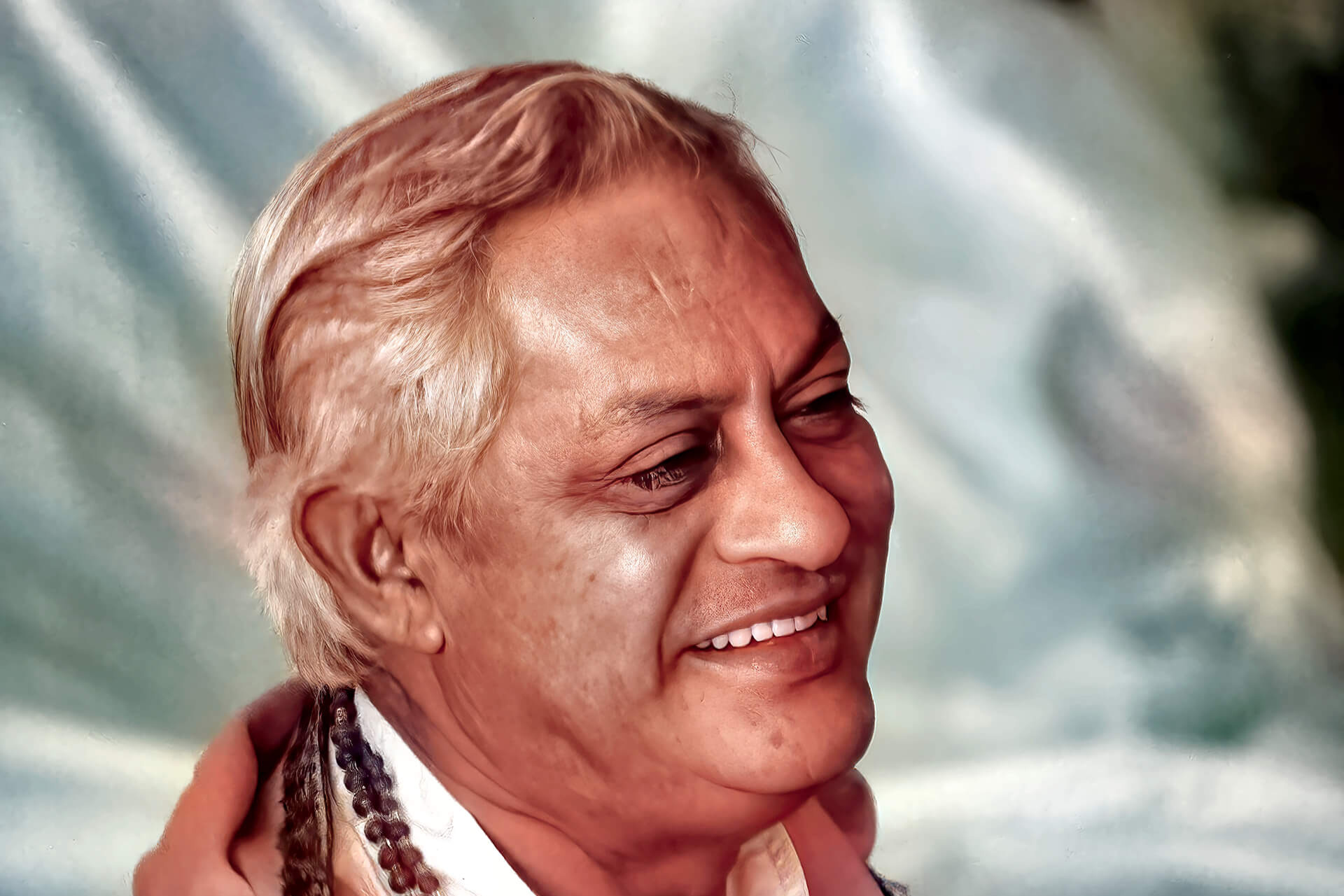

GRIEF – GRIEVING – AND LOSS
Many people do grieve because of the loss of a companion. Many do grieve because of the loss of a child, which they regarded to be their possession. There are many causes of grief. There is one sect in India that has a party when someone passes away; from this misery, this person is going into another plane where there is less misery. That is what they believe. When a child is born, then they grieve that this soul has now come into the realms of worldly misery. That is, of course, their belief.
What we are interested in is the nature of grief. What causes grief? That causes grief, which is not the loss of a loved one but the loss of oneself. It is not the loss of the loved one that causes grief. To a certain extent, yes. But grief is the loss of oneself.
What has one lost? That is the question. One has lost companionship; one has lost the person on whom one could depend; one has lost someone who provided the bread and beans. So, grief is caused by personal inadequacy, insecurity, and possession. The possessive idea one has in mind of the one that has left us causes the most tremendous grief.
It is quite natural to miss someone who has gone away, but if that grief was genuine, then it would last until you leave this world. Why does time heal the wound, so to speak? Why does time lessen the grief? Because it was not genuine grieving. It was the loss of a particular kind of need that was felt at that time, and as one gets used to the idea of not having that need any more, one grieves less and less with the passage of time.
From the angle I am speaking of, grief is primarily selfish. My son, my mother, my father, my daughter, my this, my that. You say it as if you possessed it. If you lost a piece of valuable antique furniture or a real Ming vase of the fourteenth century and it broke, you would also feel grief that this prized possession of yours is lost. The quality of suffering would be the same. So, where does grief stem? It stems from the sense of possession, and all possession is selfish.
WE ARE ALL WAYFARERS ON THIS PATH
How would a selfless person react to the loss of a loved one? The selfless person would respond this way: we are all wanderers on this path. We are all co-travellers, young or old, and some would have to reach the end quicker than others. Someone will have to get to the end far sooner.
That is the understanding that has to be developed for grief not to be so intense. For there is only one certainty in life, and that is death. It is unavoidable. Anything that is born must die. What difference will it make in the whole scheme if a person dies five years earlier, five years later, or ten years or twenty years later?
When a person passes over, he is in timeless time, and the time we measure here is unimportant in that plane of existence. There is no time in that plane of existence, and the subtle body of a person who has passed over will feel so much freer. There would be a great sense of freedom because it has unloosened itself from the physical changes or rather from the physical chains. The person who passes over is much happier than one can imagine.
The greatest thing people fear in life is death, but that is the only certainty you can expect of life. They fear death because they feel they are losing their personality, their ego, of which they are so possessive. Yet it is the very ego that is causing misery. You are possessive of your misery. You do not want to let your misery go; therefore, you fear death.
Some books include Life After Life, Life After Death, and things like that. I read some articles and some reviews on those books. They maintain it was research done by doctors, and many of you might have read them. They say that at death, every person is approached by a light that takes them to another sphere. That is a fallacy; it is not valid. I have died thousands of times consciously; I have gone beyond and have come back by will, so I can tell you what happens.
What happens is this: what you see as that light coming to fetch you is not a foreign entity, but it is the projection of your pure spirit, which is light that you meet up against. That which you have failed while you were living, you will find at the moment of death when you come face to face with your spirit, which abides in you, that light which abides in you. I have seen that light during the living states as well as during death states.
AN EXPERIMENT
I had an experience in India. I went through an experiment, and I did it just for the sake of an experiment, where I got myself buried for six days. On the verge, on the brink of death. The total heartbeat slowed down so much as if it was imperceptible. One breath was taken only before this practice was done, and they put me 12 feet deep in a box, sitting up. When I came out, I was fresh as a daisy. That one breath contains so much prana, life force or vital energy that could keep you alive for several months. I did it as an experiment. I heard it done, so I said, “Let me try,” and I did it.
With the heart just slowly pulsating, I did it as an experiment, and there was also a purpose: I had to fix up some of these arteries. Standing there on the brink of life and death, I could view both sides and the other side if people would only understand that the other side, the subtler side, is so much more pleasant. There is no suffering on the other side of this life. Although you take the subtle body with you and drop the grosser physical body, it does not suffer in that state because it goes through an evaluation process. There are no evolutionary forces there to push you on. There are no conflicts, while with the body, there are conflicts. One part of the mind pulls you this way, and the other pulls you in another direction. You are fragmented. All these conflicts are there. All filtered through what we call the brain.
ON THE OTHER SIDE
On that side, only the mind is left; the brain is not there to filter these conflicts. The organ is left behind, yet the mind, intermixing all the experiences, goes through a process of evaluation, not evolution. In that stage, you are not complete enough to evolve; you must have a body to become, combined with the mind and the spirit.
After the body is dropped, the mind exists and is empowered by the spirit. When evaluation occurs about what lessons one still has to learn, there is no suffering, and you welcome the lessons you must learn. You choose the next life that you would have to take, be it in abundance or be it in abject poverty.
If the subtle body of man, or you could call it the soul of man, was suffering on the other side, then it would never choose adverse circumstances. It would never select a body of illnesses. Some children are born ill or deformed. It would never choose to be born in poverty; it would always try to choose wealthy parents. Because there is no suffering on the other side, only a process of evolution, it would choose the proper thing for its progress. Which is, of course, conditioned and patterned by the karma and the experiences one has gone through.
If people understood this, they would grieve less. There is no suffering on the other side.
GRIEF IS BECAUSE OF POSSESSIVE IDEAS
Any grief that a person feels, be sure to know that it is because of possessive ideas, possessing a person as if it were an object. It is selfish to grieve. It is selfish to grieve because it is not in your hands. That which is in the hands of the divine plan, or the hands of the divine law, that what has to be has to be. If you think that way, how can you grieve for the person who has passed over? If it was controllable by you, and you had made a mistake, then if you were the master of life and death, grieve – but if you have no control over it, why grieve?
All the selfishness comes in. All memories come in of the pleasurable times. Oh, I had such a time with John, or I had such a time with Mary. Now, those remembrances make you grieve. Or if your son, a young man, passes away, you had all the hopes for him that he would become this or he would become that. Every parent has hopes. Because you have lost, what have you lost? You have lost your hope. Therefore, you grieve that my son would become a great violinist, musician, physician, artist, or anything significant, you name it. Because he has gone, he cannot become that. So, you start grieving.
You are grieving over an idea in your mind to which you are not entitled. That person is an entity unto himself, whether alive or not.
Grief, to repeat, is because of one’s selfishness. Grief, to repeat, is not because of genuine love. It is not true love but possessive love, and how can you call something love when it is filled with possessiveness?
I would not grieve if the closest one to me passed away. The reason would be this: that I love my wife, I love my son, I love this one or that one, and because I love selflessly, I shall not grieve, for I would know that this is a step which is necessary for that particular person, for my son or daughter, or whatever. This step is essential to the stage when the subtle body or soul is now ready to evaluate itself. In the Divine scheme of things, you can never overstay. You cannot be a burden to your host. The time for the guest has come to depart.
It is all but just a departure—just a departure from one place to the other. I will depart America and go to South Africa. Finish. Are you going to grieve about it? No. Or if I should leave here to go to another plane of existence, would you grieve about it? No. There should be no such thing as grief. Grief is a projection of one’s mind and is caused by an imbalance of one’s mind.
CONCERN IS SOMETHING DIFFERENT
There can be a concern about something different, but in all grief, there is always an “if,” the impossible “if.” “If” he had to live, then this would have been that; “if” he had to spend ten more years, then this could have been that. Oh, my son passed away, and in my old age, I have no one to look after me. The grief is not because you have lost the person. The grief is because of the loss to yourself – you have lost yourself. Therefore, the proper attitude in such circumstances should be: we have come on a visit, and the person has not expired; the visit has expired. We have come on a visit; I have come on a visit to America. I have not expired, but my visit has expired. I will be visiting somewhere else, and my visit will expire, too, so I will go on another visit.
THE SOUL OF MAN IS ETERNAL
The soul of man is immortal – it is eternal. As far as the spirit is concerned, the mind and the body are of no importance whatsoever. Because we fallaciously attach so much importance to it, that is another cause of grief.
We grieve over mortal things. There is a lovely Sanskrit prayer that says, “Lead me from mortality to immortality,” death is one of the stages we must go through. Many saints have said, “I die a thousand times every time.” Doctors will prove to you also that all of us die so many times every day. In between two heartbeats, there is a gap. That gap is death. That gap that lasts only for a split second is death. Passing from one body to another is the same thing in a different form. There is that gap that is required. The heart needs that rest from one beat to the next. The soul of man also needs that rest and period of evaluation. So, we should be happy. We pray, “May his soul rest in peace.” We pray that. We do not need to because it is going to bring greater peace. For sure!
When you say “may his soul rest in peace” you are referring to yourself, that let my soul be in peace. That is what you mean, perhaps not consciously, but subconsciously, that is what you mean. What do you know about the other soul, and what kind of peace that soul is going to? So “may” is an assumption. You assume. Wishful thinking. But, in truth, it goes to greater peace.
When this body has to be discarded within this specific Divine plan, it has to be discarded, and there is nothing to feel sorrowful about – nothing at all. Perhaps that could be the lesson you might need for your evolution. The loss of a loved one could be that lesson you need. How do you know that you have not caused so much sorrow to others in past lifetimes? You say you love your child very much. A young child, a growing child, and the child is snatched away from you. You call it snatched away because you think it is your possession. When that little child leaves us, and we feel sorrowful because of the patterning of our little minds, it could be a period of learning to aid our evolution. Also, for us to know what that agony is like or feels like, and by going through that agony, you are cleansing yourself.
GRIEVE FOR THE LIVING
Everything in this world has its time and place—there, everything functions in perfect precision. Grieve for the living. Grieve at their misery. Feel sorrowful for them, and say, “How can I help the living to lessen their burdens, to lessen their sorrow?” Grieve for the living, but never for the dead.
IT IS A MATTER OF UNDERSTANDING
It is straightforward. It is a matter of understanding. To repeat, existence on the other side is always more peaceful because the subtle body goes to a plane where the vibrations of that plane are more conducive to it, and conflict ceases. When conflicts cease, then that subtle body and mind have a chance for evaluation.
If there are conflicts, you cannot evaluate. If you have a problem to work out, a mathematical problem or any problem, and your mind is not at rest with a hundred or a million worries, you cannot solve that problem. This is logical enough to show you that on the other side, there is peace, and I talk about this through experience.
So, do not grieve. Your prayers will not affect that soul at all. “Let us pray for the dead ” is another fallacy. Pray for the living; you will be doing a good service.
How strong are your thought forces? How strong or pure are your thought forces to reach that one particular entity? They are not strong enough. When you do pray for the dead, remember you are praying for yourself—selfishness again—self, self, self. Grief has to do with the self. Pray for the living. Send good thoughts to the living so their lives can become better, enlightened, and joyous.
Grieve not for the dead. Feel sorrowful for those who suffer while in life. Pray not for the dead, but pray for those who are alive and are suffering. We will be helping the world much more in that way. The body that passes over has no control; it is going through this vital and essential process.
If we have this understanding, we can be consoled within ourselves when a loved one passes over. The greatest consolation is that that entity is working within the framework of Divine law, as you are also within the framework of Divine law—and there is nothing you can do to stop it.
… Gururaj Ananda Yogi: Satsang US 1981 – 34