
A GURU FOR HOUSEHOLDERS
Ramakrishna’s movement was mainly composed of monks. He wanted a group of people that would be prepared to become monks. He wanted people to become celibates and not enter the householder’s life, for he knew that their energies would be divided once they entered the householder’s life. He wanted their full attention to be concentrated not on gold, which meant finding work or starting a business. He did not want the attention directed towards achieving gold, nor did he want their attention to go to women. So, for his immediate monks, like Swami Vivekananda, Swami Brahmananda, and Swami Ramakrishnananda, he wanted them to avoid gold and women. That was Ramakrishna’s idea.
Through his convictions, Ramakrishna found that this would take him away from Divinity, and he wanted to reach Divinity very quickly. Therefore, he founded this ascetic order of monks.
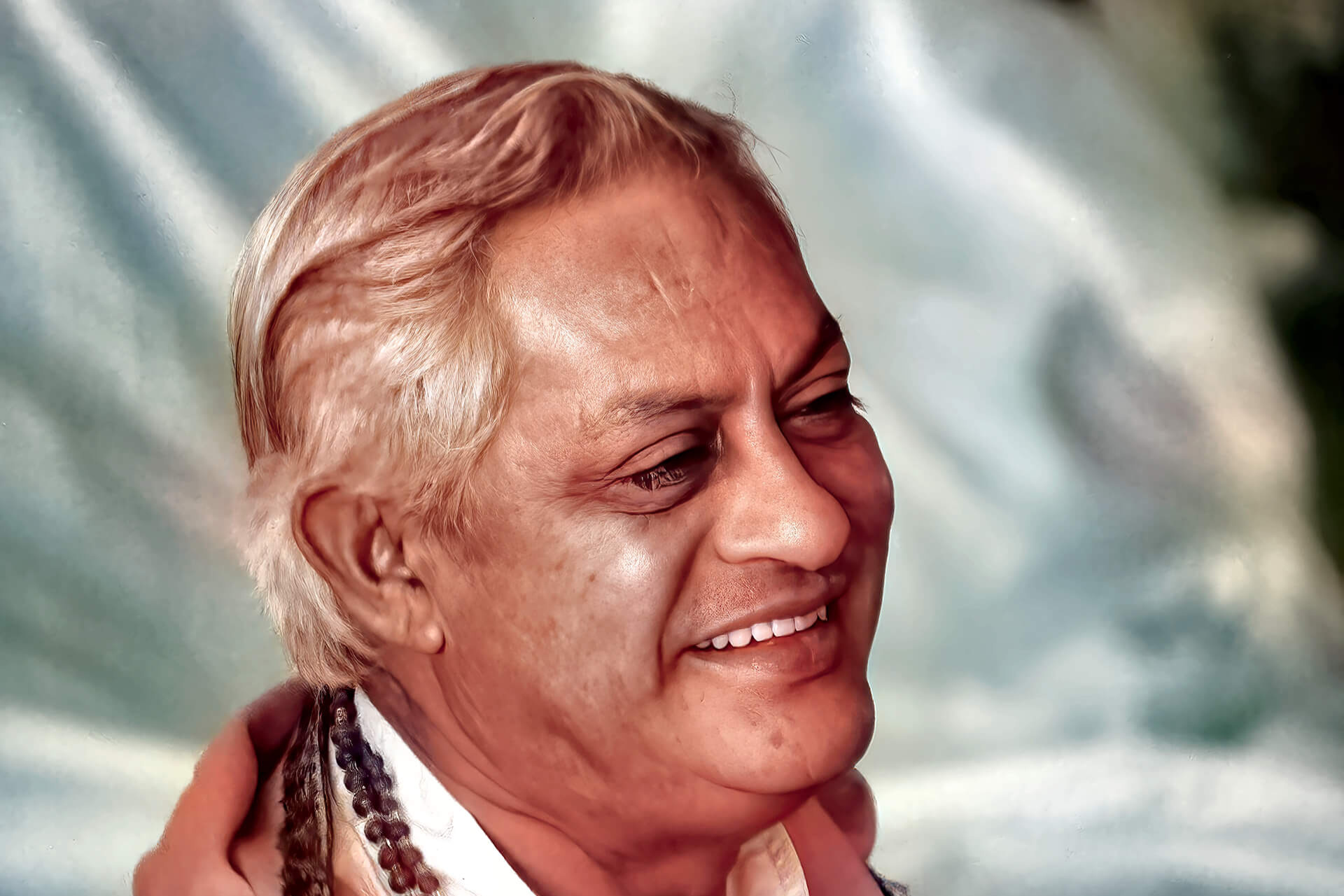
Our organization is different. I am not a teacher for monks, or else I would be in the Himalayas. I am a teacher for the householder, where a person lives an ordinary householder’s life: do well in their work and their businesses, do not engage in ascetic practices. I have found that ninety-nine percent of the world’s population is household-oriented, and only a fraction of the world’s entire population is ascetically minded.
If people are ascetically minded, I would encourage them to follow the ascetic path because that is their temperament. But as the world goes today, the temperament is to live an ordinary life: with a wife, a husband, and children, to look after their jobs and to better themselves. When a person has such a temperament, I encourage that. But I would add one thing: whatever you do, always be aware of that Divinity within you, which can be achieved through meditational and spiritual practices.
We do not believe in self-denial or severe penances, for they are not necessary. They might be suitable for monks but not for householders. They live an ordinary life; they procreate, and they enjoy the little mundane things of life, which are neither here nor there.
What I teach is that I see nothing wrong with enjoying all the mundane things of life. You can sit down to a meal and have a glass of wine with your meal or have a glass of beer. Whatever toxins there are in there, I will sneeze them out with one sneeze. That is not the criteria of proper living with the remembrance of that which is Divine.
Ramakrishna’s message was profound, but at the turn of the 19th century, he did not have the means we have today. We are fortunate to have tape recorders and all kinds of electronic gadgets where teachings can go forth in various parts of the world. He knew that that was not there, and his teachings were profound. That is why he wanted monks who would dedicate themselves without worrying about gold or women, so they would go out one hundred percent to preach his teachings.
If you read the story, those young men, about a dozen of them, starved for months. They used to go out begging and lived in a dilapidated little shack. But the determination was there. And that kept them going. So, you see, at different times, different teachings are needed.
VIVEKANANDA IN AMERICA
America only became conscious of these ancient truths through Ramakrishna. When Vivekananda came to America, the United States, he went as a monk and was known to be a monk. Some wealthy people helped him with the boat fare to come over. When he came to America, he knew no one. He sat on the pavement, thinking, “Now, what to do?” He wanted to attend the Parliament of Religions.
As it should happen, he was sitting in front of a house where a lady lived, and she had some connections with the people involved in this Parliament of Religions. She asked him in and made arrangements for him to speak. At first, he was nervous, and he kept on postponing, postponing, postponing. But when he stood up in stature, people could feel that there was a presence amongst us. And he did not start by saying, “Ladies and gentlemen.” No. He said, “My brothers and sisters of America, I come to you with a message of love and peace.” And the whole hall roared with applause.
Ramakrishna never said no woman, no gold for the entire world. He taught his very close ones so that they could concentrate all their energies towards bringing spiritual knowledge to the world. Today, after eighty-five years, that movement is established worldwide. Whenever someone asks me, “What literature should I start with?” I always recommend reading “The Gospel of Sri Ramakrishna” and the works of Swami Vivekananda, for they are great truths given.
WE EMBRACE ALL TEACHINGS
There is only one difference between what we teach and what Vivekananda used to teach. He was an in-and-out staunch Hindu, and his teachings were all angled from Hinduism or Vedanta. Our teachings differ in that we embrace all the teachings of all the great religions, and within all those teachings, we try to find the basic truth on which all the teachings of all faiths hang: the pivot. By understanding the basis and the formula, if you would like to use that word that is behind every religion, we find that all religions are but one in essence. That is the difference.
For householders, I would not advocate for no money and no gold. Everything is within moderation. It is also true that money brings greed, and all those things are connected with greed. And that could cause a lot of upsets in people’s lives.
The “no woman” business does not apply in this twentieth century. It is okay for those who want to be monks. If they are born with that temperament, by all means, they become monks. But our teachings are aimed at ninety-nine point nine percent of the people that develop a different perspective, a different attitude towards life. An attitude that is filled with hope. An attitude that shows optimism. An attitude that shows that I am potentially Divine. An attitude that shows that God is with me and in me. Who can harm me?
When these attitudes are consciously cultivated in our minds, we can face whatever comes our way with strength. For if God is with me, who can harm me?
NON-ATTACHMENT
Ramakrishna’s teachings are good. That “no woman, no gold” is good for monks. It is also perfect for householders if you understand what he meant. What he meant was non-attachment. If you understand him correctly. Have woman, have your gold, but do not be attached to it so that it hurts you.
You can love deeply and yet be non-attached. Then you know true love. If you are attached, then it is not real love. It is a dependency. If we have the dependency, what do we do? We proceed from dependency to interdependency, where a union is formed between two people. I was telling this young couple that got married, I said, “Before, the two of you used to walk with four feet. Now you are joined in this holy matrimony and walking with three feet.” It is a three-legged run through life. You are joined together. It Is a three-legged run through life. That means interdependency. But that is not the end. The time comes when you become totally independent, totally reliant on yourself, totally fired by the spiritual fire within you. Being so independent and yet so much in love. To be in the world and yet not of the world. Do you see how beautiful it is? It is straightforward.
So, when you read that passage again, “woman and gold,” have the attitude that, fine, we need that we are householders. It is okay for monks that go through very, very severe practices twelve hours of the day, where they transmute their biological urges, which are natural to man. If they were not natural to man, God would not have given them to you in the first place. They are natural to man. These monks go through at least twelve hours of practices whereby they convert and transmute the biological energies into what is called Ojas, Spiritual Light. But that is for the ascetics. We do not want that. We want to have a normal, stable society and to create that love amongst our fellow men in such beautiful harmony. That is what we want, and that is what this age needs.
Any true teacher will teach what time needs, not what is too futuristic or too far back. Teachings must always be geared to where a man stands today, and man requires harmony amongst themselves. The way to achieve this harmony amongst others, amongst our brethren, is to achieve harmony within oneself first. Through spiritual and meditational practices, we find the Kingdom of Heaven within. That is how it works.
… Gururaj Ananda Yogi: Satsang US 1980 – 10